Review: DOOM (Campaign)- DOOM Metal of the FPS Genre


Pros:
+A generous nod towards the 1993 version of DOOM
+Puts story second and places gameplay at the forefront
+Amazingly realistic and beautifully Hellish landscapes
+A metal/industrial soundtrack for fans to enjoy
+New Demon’s make for a fun and positive enjoyment of the game
+Fast Paced Combat with Demon filled “arena’s” give the game a classic DOOM feel

Cons:
-Can’t get enough of those damn demon’s


Editor’s Note: Due to the sheer size of DOOM’s content across multiple features, we’ll be breaking our review for both Campaign and Multiplayer into separate entities due to their differentiated play styles and take on the title. We’ll keep you posted when our multiplayer review covering SnapMap and Competitive goes live.


DOOM_20160516015040

Much like in previous titles, the latest installment of one of the most famed franchises in history wastes no time throwing players into the heat of combat. Within the opening moments of the game, players will find their protagonist chained to a Satanic alter where their character is soon to be executed. Within seconds player will find themselves in a rather familiar curve of adrenaline pumping combat that is fast, ultra-violent, and even demon filled. Much like every title in the franchise, there isn’t anything that’s not bigger than life in this title. This remains true as players find themselves mowing through demon’s with familiar guns such as the plasma rifle, rocket launcher, super shotgun, and even the chain gun as players move in to execute a demon with a glory kill.

If you were expecting rainbows, sunshine, and green fields? DOOM is everything, but that. As players will move across Hellish landscapes that sit true to what could consider a Christian Hell. At the forefront of bringing these landscapes to life, id Software doesn’t cut any corners as players will find things rather pumping with life across the industrial Mars station, and Hell’s landscapes. With things such as pipes, vents, shaft, hydraulic pumps, condensation on windows, and even bottles scattered across the ground bring the world to life. This is something that id Software should be proud of as Video Game Environment Design has once more come to life. While moving through each of the landscapes, players will find themselves scaling walls, cliff sides, pipes, and even industrial shipping rooms as players across the map both vertically and horizontally in order to lower down the levels of demonic infestation.

DOOM_20160513130412

If these aren’t a real thing, they definitely need to be, because they are astoundingly adorable. Plus they play the classic E1M1 from DOOM (1993).

As players do, they won’t find themselves alone as they will find conversations with the AI companion Vega or even UAC leader Doctor Samuel Hayden speaking to them through the communications systems. While this seems the only source of story, the game delves into the vast oceans of exploring codex entries where players are able to undertake a better understanding of who and what their enemies are, but also a bit more idea of what is about to come. While this seems simple, the story is quite complex and deepened by the team at id Software’s creativity. While these codex entries seem quite easy to understand, the secrets hidden with the game make this story even deeper as players will find each of the collectibles, some include chuckle worthy moments when reading about the idiocy within the UAC as they learn about demon day jobs. While these seems quite a bit to take in, it truly isn’t, and offers a variety of flavors for players to enjoy as many of the codex entries have multiple ones that can be found for more background information.

When you aren’t digging through these for information, the game focuses on the use of verticality like no other game has. Maps are not linear arenas where players will simply run around pillars with their hands flailing in the air as if they were about to beat up by the schoolyard bully. Instead this game insists on players scaling walls, pipes, shipping containers, walls, and fixtures galore in order to take out their nearest by enemy. With the design that id Software aimed for, players will find themselves constantly moving forward, climbing up, jumping down, and ultimately feeling like the genuine badass that the game wanted you to feel like. Thanks to this maps are not boring, nor will they be seen in the same way each time they are played. Instead each of the maps persists in being a living creature and manages to do so as each of them come to live in a blood bath of demonic blood and body parts. Let alone do each of the environments live thanks to the creativity of the level designers and artists, the game also tells a vivid story with each room that will eventually be flooded with demons.While it would be quite easy to carry on about the level design, the monsters have also gotten a rather unique re-imagining that brings them to life no more than ever.

DOOM_20160515182004

Bosses are bigger, meaner, and more pissed-off than ever. Also, they don’t go down without their say so.

As it would be hard to imagine, demons have been reimagined to have a more Hellish look with a sense of cyberpunk twists to them. This includes the famed Cyberdemon, Mancubus, and even the famed Revenant. All are more terrifying than ever as they are now twisted flesh, machine, and weaponry that will send players riveting in pain when hit by them. While their combat tactics seem all too familiar, they don’t hesitate pursuing playes in lethal ambushes. Within my 26 hour campaign that included 93% of all secrets found on Nightmare, I found myself constantly running for the nearest enemy in order to glory kill them. This only soon lead to familiar enemies like the Hell Knight or even the all-to-familiar imps as well as the scary as hell itself Barons of Hell turning my character into a visceral mess. Let alone will they pursue the player, they will not hesitate leaping up after the player or unleashing an entire payload of attacks in a attempt to take players out at their own will. It’s terrifying at the concept that these demons seem more real than ever, but to know they don’t hesitate climbing up after the player? It’s even scarier when seeing a Mancubus’ large cannons appear on a ledge while it pushes itself up only to unleash a torrent of flames or plasma like energy at the screen.

If players are quick enough, weapons equipped can unleash Hell itself upon enemies. Let alone do weapons also get a redesign like the monsters, DOOM offers up something it had never done so before. Weapons have been given a much needed redesign. While the pistol itself offers up a unique blend of being powerful as its precision shots can offer a honest amount of damage, but is quickly quieted by much bigger weapons. While weapons such as the Heavy Assault rifle can offer precise shots or even a salvo of micro-missles. Weapons such as the combat shotgun can be used to stun enemies with a grenade round or even offer up a quick burst of shots that can stun enemies like Pinky and even Hellknights to open up players a chance of opportunity to unleash a few more extra hits in while they recover. Once the damage needed has been built? Players can move in to Glory Kill their enemies if a large enough amount of damage has been dealt. This lethal blow can offer up a gory animation that will satisfy any player who doesn’t mind some blood, guts, or even broken jaws. Once done players will find themselves being given health drops, ammo drops, and or even some armor depending on the demon runes equipped.

Revenant_Fight_1437988262

Think the Revenant is the biggest and most baddest of this group? Think again.

While combat has taken a huge re-work that pushes players forward through moments of combat to ensure survival, there’s a bit of work that has been done in the background. While the game will offer challenges for players to unlock Demon Runes that will offer perks such as “Armor Shards” on pick-up, “Extended Power-Up Duration”, or even other “Larger Pick-Up Radius” these items won’t be easily earned. While many players may see a few of them up for grabs, many of these Demon Rune shrines are hidden throughout many of the games levels, and each come at a cost. The challenges are the cost. While some of these challenges are quite easy, such as “kill ?? imps before the time runs out”, others are even harder as players will find time quickly ticking down as they attempt to take out Hellknights using a shotgun only to attempt glory killing them from above.

Let alone do these runes benefit player, they are not nearly as beneficial as the weapon upgrade unlocks or even the games “Ardent Shards” that can be picked-up in order to upgrade the suits lethality. This includes three important things that will bend the way combat favors the combat, but not enough to make you a total badass without some skill. the upgrades include health, armor, and ammo. All three can be obtained for those who decide to traverse the various paths in each level as well as going out of their way in order to discover secret rooms. While it sounds like the Praetor’s upgrades may make you feel like a badass, don’t feel this way. Those upgrades are only minor and still mean players can quickly find themselves in a deathworthy situation as enemies such as the Baron of Hell or Cacodemon look to eat the Doomguy alive as if he were a gummy shark waiting for a toddler to eat.

DOOM – PlayStation 4 (Reviewed), Xbox One, and Windows PC.
Developer: id Software
Publisher: Bethesda Zenimax
Price: $59.99 USD
Released: Available Now

While it seems that DOOM offers up plenty to discover, the game doesn’t attempt to overwhelm the players who decide to traverse each of the game’s missions in order to uncover what is going on or why. The game itself is not shy that it’s simply about four things: Big F**king Guns, Heavy Metal, demons, and Hell getting its ass kicked in. If you are a fan of DOOM or new to the series? DOOM (2016) does it right and doesn’t shy away from its origins in any form. If this is what the future of DOOM remains to be and continues to do so with fine-tuned tweaks? I’ll be on board for another 23 years to come.


Our review is based on a copy we purchased for review.  For information about our ethics policy please click here.


 Final Score: 10 out of 10


About the Writer:

dustin_batgr_prof

Dustin is our native console gamer, PlayStation and Nintendo reviewer who has an appetite for anything that crosses the boarders from across the big pond. His interest in JRPG’s, Anime, Handheld Gaming, and Pizza is insatiable. His elitist attitude gives him direction, want, and a need for the hardest difficulties in games, which is fun to watch, and hilarity at its finest. You can find him over on TwitterGoogle+, and or you can find him on PSN with RaivynLyken.

Review: Dark Souls III – A Dark and Twisted Soul Awaits


Pros:
+Graphics are on par with the PlayStation 4 Exclusive Bloodborne
+Combat flow is smooth as well as crisp
+Musical score is phenomenal at setting up the emotion felt with each zone
+Armor designs heavily reflect on both Dark Souls and Bloodborne titles
+Difficulty scaling is insanely fun and moderately easy to-adapt to
+New enemy types fit well with some of the revisited areas such as Anor Lando
+New weapon arts allows for a new pace as well as flow in combat

Cons:
-Major latency issues in PvP and Co-Op (tested on 200D/25U MBPs internet)
-Difficulty in navigating areas remains about the same for veterans


DARK SOULS™ III_20160427183154

When Demon’s Souls launched on PlayStation 3 many gamers new something dark was looming in the air. The title was not easy, it was not fair, and it would punish a player however it could. Known for meticulous fights, devastating fights, and humiliation in any form; the Souls series by From Software has become one of the mos beloved franchises around the world. With bosses the size of castles, weapons that are inhumanely scaled, and armor designs that would make a D&D fan’s heart melt, the game has taken the world by storm. With five Souls style games under their belt, From Software has made a path of their own in the past eleven years. With a difficulty that goes without moderated in any form, PvP is brutal, enemies are devastating, and even the terrains await to perish a player who ventures through them. This was much my case with Dark Souls III, the final chapter in a franchise, and one that I’ve come to love dearly due to its grueling scale of difficulty. With 69 hours, 32 minutes and and 19 seconds under my belt, I was able to conquer a title in PvP, PvE, and gear farming in an astonishing way that even a Souls fan would appreciate as I had left almost every stone turned and every corner checked on.

When it was first announced that Dark Souls III would more than likely be the end of me seeing relentless enemies with sharp pointy things chasing me down, slaughtering me, and taking me outside to beat on me some more once a corpse, I felt a certain bit of me begin to break apart after having realized that my thousands of hours between Demon’s Souls, Dark Souls, Dark Souls III and the “successor” neglected red-headed step-child Bloodborne were coming to an end, my heart sank. After all, a certain sadistic and twisted side of me, I’ll admit loved the brutal punishments. There was nothing like having an undead knight in silver armor chasing me down, brutally waylaying on me to death, and then proceeding to knock me around with his shield as a form of entertainment. The truth is? A certain part of me loved it when I finally managed to parry his attack with my shield only to grotesquely submerge my axe into his neck, and walk away with a toothy gri on my face. Only to b e moments later hit with a fireball and sent to my untimely death due to another player having invaded my game.

DARK SOULS™ III_20160428020154

When looking at Demon’s Souls, Dark Souls, and Dark Souls III players will notice that the series has taken a familiar twist back to originality as series director Hidetaka Miyazaki has now returned to the franchise, the game takes a path away from what Dark Souls II had done, which offered a different director, a changed pace in difficulty, and a derided hub-based game world, boring armor clad monsters, and a world that seems, at times, a disappointing visual world, Dark Souls III once more brings the sun to the series, and shines a light back on the franchise. Even as an exit, Dark Souls III has redeemed the series with a return to all things old as well as things new including the return of Artorias’ equipment, Anor Lando from Dark Souls, and even a nod towards covenants that’ll seem all too familiar for veteran players. While hardcore fans were disappointed with Dark Souls II, Dark Souls III has managed to redeem the franchise on a high-note.

When looking at the Dark Souls series, we have to focus on how bad as well as good Dark Souls II was, and to do so we have to bring up the central hub Majula from Dark Souls II. Majula, unlike Firelink Shrine tried to setup a central hub. One that felt alive, interactive, and one that players would become rather familiar with in a rather intimate way. In Firelink Shrine, players will come to use this place as their rest stop, one that serves as both leveling area and even their place to shop, upgrade, and create. As players become familiar with things such as upgrading their equipment and meeting new NPC’s that will appear in Firelink Shrine, players also might reflect on the fact the original central hub also went on by the same name. One that led us to several new areas, including Anor Lando, among many other fun and lovely places that killed us more than once.

Much as the game feels like a rebirth of Dark Souls, the third installment is the one that feels truly alive as players bring in new NPCs, but also the world around them. While many players may find that these NPCs seem familiar, some of them may not seem as familiar, and that may be due to the fact players have yet to unlock their quest lines or covenants, unless they’ve met the jerk that decides to send players constantly to a place of their own demise. While this is common in the title, Firelink shrine serves as a place where players can find some solace in their adventures, and even a place where a few deep breaths can be taken. While seeing as many characters than fingers on your hand coming and going from the Shrine, it’s interesting to see as it gives a sense of atonement for past doings and even believable context to a world that isn’t living and breathing to help you out.

DARK SOULS™ III_20160426000640

Scenery like this isn’t uncommon and remains a large part of the game throughout the adventure.

As many of you know, Dark Souls is a beautiful franchise, artistically it is almost impeccable at its detail. While the series itself has been a disturbing mess thanks to Blighttown (I’m still not sure I’ve recovered from that nightmare), which is hailed as the most painful, ugly, framerate eating, and most painful locale int he series, it’s a zone that has presented players with trouble over the years, and to this date seems to do so. Dark Souls III, however, has been a departure from that issue as much of the title on both Xbox One and PlayStation 4 has been able to sustain its 30fps goal and even managed to cut down on most of the framerate problems that previous entries have had.While never having played the series on PC yet, the game has managed to stay smooth, fun, and even enjoyable while some of the areas such as the swamps did manage to bog my framerate at certain points. This happened more-so on the Xbox One than on PlayStation 4, but both id see this occur to say the least.

While you may read that the PC version encounters various pop-in’s for terrain and enemies, the PlayStation 4 and Xbox One versions both seem to encounter this issue, even with the newly released Version 1.04 (regulation 1.05). The problems have actually seemed to have smoothed out in some of the more high-end locations such as the Profane Capital where flame particle effects as well as shadow effects are numerous and push the consoles to their limits. As my good friend Damien said, the zone made my PlayStation 4 sound like an airplane prepping for takeoff during the height of a war, which remained true in many of the games stages such as Smouldering Lake, Irithyll, and even the Grand Archives where lighting effects were numerous as well as enemies.

DARK SOULS™ III_20160424225000

As much as this seems welcoming with sights that will take ones breath away, the sights are not something that will keep you at ease when burning torches and patrolling skeletons come into range, and before long an ambush awaits. While players may feel at ease momentarily, that is not something that Dark Souls wants as players will find themselves gritting their teeth and banging their head on the wall because of. It is something that becomes a painful realization as players may find the weight of danger almost too much to bare.

While this does offer some relaxation to players, this small breath of air is not one that will help players take in as much hope as they would. As much as combat seems fluid and welcoming, Dark Souls III does offer a quicker pace of fighting with the “Combat Arts” that brings new maneuvers to weapons. Weapons such as the Wolf Knights Greatsword’s fighting stance, players will find themselves favoring the weapons primary fighting stance after pressing triangle. While holding L2, players can hit R1 or R2 in order to do a power attack that uses both FP (mana) to do a power attack that will send players in a whirling attack of death when doing a front-flip with the weapon in town only to knock enemies down. While one would expect some cinematic spectacle to draw in nearby viewers in the same room, these are to bring a new unique bit of combat to the game and even partially influences one of the games boss fights, which brings the uniqueness to the forefront as players will find themselves bringing the down as quickly as possible. This heavily reflects bosses that are hidden within the game by covenant choices as well as hidden bosses that require certain requirements to unlock their zones.

DARK SOULS™ III_20160427025200

While combat itself accents both the cinematic beauty, musical score, and the dark gothic settings – Dark Souls III can be considered the greatest hits of the franchise as it takes the best parts of all three titles including the lost step-child that’s a PS4 exclusive known as Bloodborne. While the game itself may feel short for players that dart through it, veterans that love to turn every stone possible, the title holds plenty of surprises around every corner and even a few nods towards the original titles as players hammer away at enemies of massive sizes. While this is a departure as the last title, the ending feels complete, and will leave players holding their head up high with astonishment at the farewell the title brings forth. While it’s bittersweet, the title does offer coop and pvp in excellent ways that will keep the title alive for years to come, even when DLC launches later this year.

We just hope to see From Software keep the spirit alive with their future games. For an exit? This game shows how to perfectly depart from a series that has taken hearts by storm for those who like grueling difficulties. As for us? It is a perfect painting we’ll be appreciating for years to come.


Our review is based on a copy we purchased for review.  For information about our ethics policy please click here.


 Final Score: 9 out of 10


About the Writer:

dustin_batgr_prof

Dustin is our native console gamer, PlayStation and Nintendo reviewer who has an appetite for anything that crosses the boarders from across the big pond. His interest in JRPG’s, Anime, Handheld Gaming, and Pizza is insatiable. His elitist attitude gives him direction, want, and a need for the hardest difficulties in games, which is fun to watch, and hilarity at its finest. You can find him over on TwitterGoogle+, and or you can find him on PSN with RaivynLyken.


Review: Stranger of Sword City – Swinging Swords in the Dungeons of the Future

Pros:
+Strong combat mechanics that reflect upon classic row-based fighting
+Character classes offer unique blends in combat and require player awareness
+Difficult to start out, but lightens up as players progress
+Hiding mechanic offers a unique twist to dungeons
+Character portraits are top-notch as well as enemy portraits. Astonishing artwork

Cons:
-Typical “become the hero” plot that doesn’t leave this theory behind much
-Combat gets repetitive after a decent amount of time
-Difficulty scaling rapidly decreases and declines with time


SoSC English Screenshot (3)

It’s hard to admit that both the Xbox 360 and Xbox One have been making difficult strides to be hubs for JRPG titles. The Xbox 360 saw exclusives such as Infinite Undiscovery, Lost Odyssey, and a push at titles like Magna Carta 2, which has been reasonably well received all around. Microsoft’s attempts, however didn’t end there, and remain to keep right where they are at. That was until Sony’s beautiful handheld, the PlayStation Vita for those wondering, received a unique diamond in the rough. Luckily for the PlayStation Vita, this isn’t something all that odd nor is it something all that unique since the handheld thrives like a shining star thanks to JRPG games. Unfortunately for the Xbox One, it has not even come close to tapping into JRPG games as it did in the past nor does it seem even close to grabbing onto the JRPG market like the Xbox 360 had. Luckily? Stranger of Sword City managed to slip in between the cracks and attempted to fill this gap, but for the Vita? Does it even manage to fill a much needed spot in the latest of game releases? That’s where we come in to discuss this title by Experience Inc.


Be it odd, the world seems almost non-existent when it comes to modern day dungeon crawling JRPGs. Sure we’ve seen a few titles out there, but nothing that really sticks its nose out and tries to be unique. Yea we’ve gotten titles such as Tokyo Twilight Ghost Hunters, Lost Dimension, and a few other various titles on the PlayStation vita, but none that went back to the traditional look of things. Unfortunately for the Xbox One this isn’t the case, which makes the catalog comparison rather difficult when it comes to Microsoft’s home console. However, the game takes familiar turns for some players that are used to the first person view RPGs that require them to tap multiple times to go in a single direction, block by block, which isn’t seemingly uncommon anymore. If you’ve ever played a title like Wizardy back on NES? These game types are a strong nod to the type of JRPG this one is. However, for some of you? You’ve probably imported the game since it originally released in Japan on PC/Xbox 360 back in 2014 and just now made its way stateside in 2016.

SoSC English Screenshot (8)

If you ever watched a show like Lost, imagine it has teamed up and had a child with a good game of Dungeons and Dragons, and that’s what the game delivers, but with an awkward start since players start out with a rather large plane crash. After it happens, the story takes place of our avatar waking up in a dimension unfamiliar to them where creatures known as “Lineage” have taken over and the monsters guarding them have overrun the world around the player. With a fair number of other humans and otherworldly creatures here, the avatar will be teaming up with other humans labeled as “Strangers” who are also strong and talented like your own, but that would be thanks to the lower gravity.

While players get underway, they are quickly going to witness their character being titled the “Chosen One” who will cause players to put into the middle of a rather large faction dispute. One where their new world is run by Three Kingdoms, all ruled by strangers, who are all combating for Blood Gems, which will allow them to gain god like powers that can only be obtained by slaying “Lineage Type” creatures. Surprisingly enough? Players will be able to support one of these three kingdoms in order to obtain Blood Gems and attempting to return home to your world.

SoSC English Screenshot (6)

Unlike titles such as New Tokyo Legacy Operation Abyss or Operation Babel, Stranger of Sword City is not an easy title nor is it an entry level JRPG. Instead the game starts out with varying degrees of difficulty that will leave players cringing with each step as they attempt to play. Even on the “Easy” difficulty the game has presented challenges a long the way that will cause players to cringe as they begin to find that even some of the easiest enemies are some of the hardest to fight against. Let alone are fights difficult, the menus for the game alone are quite difficult to explore while players will find themselves struggling to manage through them. Let alone are they hard, players will also find the leveling system is a bit more complex than just achieving the experience needed to level up, but also the fact that players will need to navigate the party menu in order to highlight the character they need before hitting LB/RB or L/R depending on if on Vita or XBO. Once done players can choose a single stat point to place depending on where they want it spent in order to provide a better challenge for enemy characters.

While in combat, players will find themselves cringing in pain while trying to revive party members. Unlike the main character, however, secondary characters can suffer from perma-death after being revived 2-3 times at max. Unfortunately, this mean training new characters. Players will need to prepare rather heavily when attempting to dungeon dive in order to keep party members at full health. This challenge provides a constant new face on the team if players make the fatal mistake that will lead to one of their party members being killed rather quickly. Their revival points? Are also determined on a characters age, which will come at players debating whether they want more skill points to assign of if they want more revives. This weight comes at heavy costs depending on how skilled players want their characters or how many times they want to bring them into combat.

SoSC English Screenshot (3)

For combat, players will want to spend a decent amount of time planning out their teams roster. For me? This meant creating 1-2 characters of each class and rotating them out as I went back to town to heal, but also to buy new equipment. The reason behind this? If a party member dies, it means that players will take 24 in-game hours to revive. If that’s not enough, players will find themselves rotating their characters out in order to keep the roster full. While this sounds fun and all, these replacement ally’s will start out on the spot fresh or where they left off in each dungeon, XP itself means that they will be under-leveled for a few hours in. Luckily, if you have back-up party members, they will gain experience while resting and as your main team goes through combat. Luckily characters generated by the player will scale to the players progress. It’s still suggested to get them the gear they need to provide a top-notch experience.

While a lot of these design choices are rather odd and offer a unique combat experience unlike New Tokyo Legacy Operation Abyss, players will find themselves managing everything quite easily within a few hours of gameplay. It is suggested to take some time reading the manual in order to learn controls, status effects, etc while players dig through the game itself. This will lead to payers appreciating these small stalling factors once they get underway with the title. Fortunately the complications begin to go away as players learn to upgrade gear, fetch quests, and take on random encounters that include ambushes that players can set up. These ambushes will carrying loot that players can take if the “boss” enemy is taken out in time. This means players can use the “Check Monster” in order to check their levels and types. This will also allow players to see what loot they are taking on that can include rings, weapons, underwear, and even usable items for player sin order to determine whether the risk of fighting these creatures is worth it or not.

SoC_Artwork_Comparison

Stranger of Sword City – PlayStation Vita [Reviewed] and Xbox One [Reviewed]
Developer: Experience Inc.
Publisher: NIS America
Price: $39.99 USD
Released: Available Now

If players decide the loot isn’t worth it, they can pass and wait for the next group, unfortunately doing so will allow for players to be ambushed in turn. If they decide to flee, they can leave this “Hiding” option in order to flee all together. This option can’t run forever, this means a completing a successful or unsuccessful combat means that players will use and or raise their Divinity Points that allow for unique experiences. This will allow players to hide or flee from combat if they are ambushed. While items are obtained in combat, players can use a “Identify” option to find out what items are. This means they can find rings, monster parts, and or strange items that may or may not have any other attributes to them. From here, players can choose to identify them constantly, but this option can fail due to a players luck. If the option fails the item becomes cursed and will be required to be cleansed upon leaving the dungeon so that players can use it with a party member. This doesn’t offset the amazing art styles that can be chosen through the games options menu. While this is minor it does offer a varied experience for those wanting a more realistic portraiture for each character.

While the games mechanics are thoroughly dismissed in tutorials, the options can be quite easily learned if players have the amount of patience needed for it. Even with this unnecessary learning curve, players can easily learn the game as time goes on throughout it. While it provides a unique experience challenges are present at every corner and welcome players to conquer them by any means necessary.


Our review is based on a copy provided to us by the games publisher.  For information about our ethics policy please click here.


 Final Score: 7 out of 10


About the Writer:

dustin_batgr_prof

Dustin is our native console gamer, PlayStation and Nintendo reviewer who has an appetite for anything that crosses the boarders from across the big pond. His interest in JRPG’s, Anime, Handheld Gaming, and Pizza is insatiable. His elitist attitude gives him direction, want, and a need for the hardest difficulties in games, which is fun to watch, and hilarity at its finest. You can find him over on TwitterGoogle+, and or you can find him on PSN with RaivynLyken.

Review: Koi – A Graphical Beauty in a Pond Full of Big Title Games

Pros:
+Graphically beautiful even for how simplistic the title is
+Gameplay offers a variety of gameplay types in a single title
+Collectible hunting is thoroughly enjoying
+A musical score that is enlightening and relaxing to listen to while playing

Cons:
-Menus are hard to navigate as they do not highlight what the menu items are


KOI_20160114065615


When we think of Koi we think of their artistic uses, their beauty, and the fact they represent inner peace to a lot of people. We also think of the fact they are highly revered in many parts of Asia, which makes this title rather unique of a choice for China’s developer studio Dotoyou to release the game outside of China. With the console ban having been lifted last year, it’ll be interesting to see if we get more titles like this, but for now? This small indie title is more than enough to give some attention to the import market that seems to be making its way over seas.

As someone that’s always hard pressed to be entertained by indie games, I was taken back a bit when Koi was presented to me through our teams inbox. As I stared at the review code I was curious to more about this title. Sure I’d glanced over the press emails a few times, but I didn’t, at the time, feel that Koi would be hard pressed to grab the attention of many of our readers. After a short bit, I decided to boot up the PlayStation Store via my phone, enter the code, download, and sit down in front of my PlayStation 4 to see this title that had been sent to us. As an introduction to Dotoyou’s title Koi, I was introduced to it by a very simple appearance at first, the title screen was warm, welcoming, and quite easy to take in. Once entering the main menu? Well that was a task of its own, but after a few minutes of trial and error? I found myself being introduced to this simple, artistically easy on the eyes, and musically warm welcoming title.

KOI_20160114064852

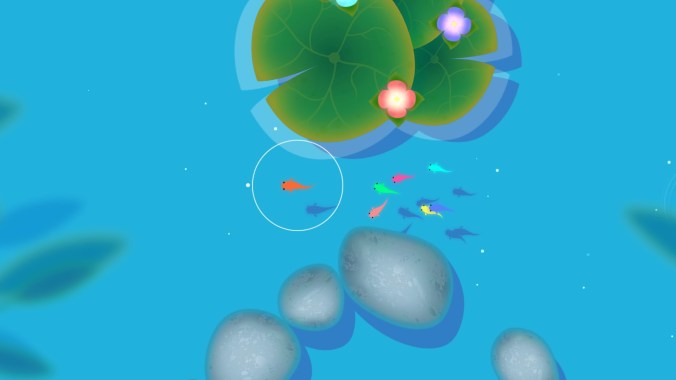
Dotoyou’s title is a charming one, one that greets us right from the start with the realization this game will seem rather simple, so much so that I’m surprised it’s not a tablet game instead, but it it’ll make do on PS4 thanks to titles such as Flower and Flow that show titles like this have a spot on home consoles. When starting to play, Koi is rather simple to begin. Players take control of an orange Koi who seems pretty happy in his or her home river, going under lotus blossoms is charming , but quickly turns into a puzzle as players will be hard-pressed to navigate to missing Koi that will be required to open each one, and through them activating a piece of the musical score is rather charming as each fellow koi opens a lotus blossom. After a short while? The game begins to take a different pace as black, much larger, and rather angry koi begin to take over the streams.

As they do players will find that this game is no longer just about finding their friends, but also trying to survive in a much more brutal setting. One that requires patience, resilience, and the ability to navigate patrol paths. As players get this down, the story begins to unwind itself as the music grows darker, settings begin to change, and the evident story underneath the pages reveals itself. While the game seems to be about a koi surviving in a world that is changing, the game isn’t just about that. Underneath it, the game expresses a very real problem for China, one that isn’t just about economics, population, but one that is evidently about China’s ongoing pollution issue. One that has left our digital friend in dismay as the world around him or her gets dirtier, harder to live in, and just purely more volatile than ever.

KOI_20160218023155

Koi – PlayStation 4 [Reviewed]
Developer: Dotoyou
Publisher: Oasis Games
Price: $9.99 USD
Released: Available Now

As the game progresses puzzles will variate into “Simon Says”, grid based puzzles, and even a match making puzzle. While the difficulty in doing these seems like they should be evident; the challenge however isn’t, and it says the same through out the game. While this may be welcomed by some, those looking for a scale in difficulty won’t find it with this game as it is a game that seems to have been made for players of all ages. While some of the most innovative changes were subtle, they didn’t stick throughout the game nor did this ideology move to the overall title itself where players will find themselves scratching their heads as one of the levels offered up the ability to be taken backwards by water currents while others included avoiding the much larger back Koi’s that sought to eat the playable character. While the game does offer up collectibles, they’re not as overall hard to find as one would hope. Sure one or two hid under twigs and lotus blossoms, that was about as difficult as most of them managed to get. Unfortunately, the game is short, ranking in at roughly 4-5 hours at tops depending on if you are treasure hunting or not. For those looking for a short exploration through some very real problems in China and around the world? This is a game that is creative, beautiful at every bit you could expect of it.


Our review is based on a copy provided to us by the games publisher.  For information about our ethics policy please click here.


 Final Score: 7 out of 10


About the Writer:

dustin_batgr_prof

Dustin is our native console gamer, PlayStation and Nintendo reviewer who has an appetite for anything that crosses the boarders from across the big pond. His interest in JRPG’s, Anime, Handheld Gaming, and Pizza is insatiable. His elitist attitude gives him direction, want, and a need for the hardest difficulties in games, which is fun to watch, and hilarity at its finest. You can find him over on TwitterGoogle+, and or you can find him on PSN with RaivynLyken.

Review: Warframe 18.5, Sands of Inaros – When The Sands of Time Chip Away the Old Paint

Pros:
+New Lighting engine allows for a subtle change in how shadows and lights work.
+Storytelling follows a familiar trail that was witnessed with “Second Dream” content.
+New Warframe offers not seen before mechanics in the game that works quite well.
+New tilesets offer a breath of fresh air to older tilesets.
+New weapons and character skins offer quite a new appeal to the game.

Cons:
Various bugs that are being reported on the forums regarding interface bugs and performance ones..
Inaros quest objectives can be difficult to find for some without a guide.


WF_SoF_SC02

There’s always been a place in my heart for new additions to games whether they are new and old. This has been something that has been amazing about Warframe with each passing day. The game has received more content than one would expect to keep the game fresh, but not ultimately changed to the point of being hard to notice due to these changes. The latest addition to these subtle changes comes in the element of mission objectives and storytelling that once more drives this content update home. This time around the game doesn’t revolve around many protagonists we’ve come to know such as “Natah” aka Lotus or even people such as Teshin, but instead our story evolves around a lesser known character by the name of Baro Ki’teer. The update itself also revolves around the game’s mechanic upgrades that evolve around mechanical and systematic upgrades such as lighting, texture collision, and even small tweaks to offer a more fleshed out experience for those who have been playing the game, but also for those returning to it.

At the heart of Sands of Inaros is the campaign, something that Christopher Adee and myself spent plenty of time with in order to experience it for both the “E.O.D. Tech Site” as well as this review. In Sands of Inaros we are given the glimpse into a civilization that had been wiped out due to a mysterious invasion, one that left a once thriving village in peril upon attack, and eventually lead to them having been wiped out. In turn it has become a task for the player to uncover the truth of what happened and the truth behind the Tomb of Inaros that has caused this Warframe to go hidden. While players do this they will find themselves undergoing the game with several new features such as lightning, particle effects, and even more detailed shadow effects. This truly shines while doing the Sands of Inaros missions where players will see several new tilesets that offer a variety of appearances for the game.

As much as the story would be one to discuss, the story is one of the several things about the update that truly shines. While I wish I had footage that could compare pre-Update 18.5 to 18.5, I truly wish it were plausible to emphasize on how well the lighting and shadows have been vastly improved upon, but so has the Sabotage missions, which now stand at Reactor Sabotage 2.0. This new variant of Sabotage is quite fun as it is no longer a single ball that spins repeatedly forcing players to shoot at it until each reactor shard is broken, but now has reactor pipes that players must destroy in order to start the complete melt down. This alone has offered up a nice change for the game. Along with this subtle and welcomed change, we are also greeted with new change on how we can gain Focus for the Tenno, which allows for players to have a chance at getting even more XP towards their focus and giving them the ability to level it up or to unlock their new focus they are using if they’ve already moved onto the next one. Convergence, however, is what causes these Focus items to drop as Convergence is a unique pick-up that lasts for a short amount of time and will spawn at a random point on the player’s current tileset in a short distance from them. This is indicated with a new icon and allows players to have a 6x Focus multiplier for 45 seconds that allows for players to enjoy their killing spree.

WF_SoF_SC01

With this new change, player focus has also been increased from a daily cap of 75k to 100k as players will be able to get an increase with the type of lense they are using in the following increments:

Normal Lens: 1.25% without Convergence
Normal Lens: 7.5% with Convergence (multiplied by 6)
Greater Lens: 1.75% without Convergence
Greater Lens : 10.5% with Convergence (multiplied by 6)

With these lenses players are able to increase their chance at upping their abilities for their Focus and enabling their Tenno to become one of the most powerful enemies that the universe has ever seen. We can only assume this will change overtime since the Focus system is in early beta at this time.

Along with these changes comes Season 4 of the Sortie Missions, which are quite addicting, albeit they are challenging enough that some players will skip their daily sorties for the current day. Sorties now have two reward seconds: repeatable and non-repeatable. The rewards window does now emphasize what awards players can and can’t get multiple times as they play through. The non-repeatable missions are checked off when obtain and will not allow players to obtain them again for the season. Instead it is replaces with things such as Rare 5 Fusion Cores, Bundles, etc, depending on the players unlock. This could change overtime and allows for a nice change of pacing for players who are dedicated to sortie missions on a daily basis.

For many, Inaros himself will be the focus point of this content update as he offers a unique twist to Warframes known combat systems. As a first, Inaros does not come with a shield at all. Instead players will find themselves relying on his abilities to control combat by blinding enemies with Desiccation, which blinds enemies as Inaros knocks sand in their eyes and debilitates them, opening them up for a completely powerful blow that can one shot just about any enemy on the field. If he does? His health is restored, which is quite important as combat is already fast enough and enemies die quicker than needed at some point in combat. His second ability is another unique twist, one that takes notes from Nekros’ “Shadows of the Dead”, which is called Devour, which allows him to kill an enemy, heal while doing so, and summon a sand form of them self. Amidst battle he excels and changes the battlefield rapidly by turning into a sandstorm. Lastly is his ultimate ability, “Scarab Armor”, which allows him to decrease the damage taken while combat. In turn he can also turn this ability into an offensive capability where he will unleash it upon enemies so that his scarabs may damage the enemy and heal him at the same time.

For those wondering about the new weapons called Lesion, Mutalist Cernos, Staticor, and Dual Toxocyst will not be disappointed with just how powerful these weapons actually are. Their enjoyment is actually brought forth a unique experience that some may be familiar with while exploring the game with them. The Lesion is a rather powerful polearm that delivers a powerful blow as it increases in attack speed with status procs. Much like how the Mutalist Cernos fires off Toxin damage where it’s arrows land, but the Dual Toxocyst also speeds up as it kills targets with critical hits. As for the Staticor? It delivers a powerful blow that knocks enemies back while taking them out of the fight if they can’t take a hit from it once it’s charged up. Each of these weapons offer a unique twist to battle as enemies will learn to fear the armament of the Tenno. While we wish there was a new sentinel, the new weapons and appearance items offer enough for us to enjoy and keep at what we are doing and how we are doing it.

Warframe_ThirdAnniversary_DexSybarisRifle

While this update could be even bigger, it’s nice to see that its overhaul, a whopping 7.8GB’s on PS4 and Xbox One, brought a nice bit of changes to the game and keeps on making the game feel as though it is a triple “A” title. While it is a free-to-play, the development team has been loyal to it, bringing the title forth even more with new mission types, more titleset possibilities, constant giveaways, and even playing with their own fan base during their weekly live-stream. Even though this review could be much bigger, it’s hard to truly dig through what this content update is about and leaving Christopher Adee a chance to talk about more-insight to this update via his upcoming “E.O.D. Tech Site”, but much of the content appraisal is because of the content that is still up and coming, that will leave this review as in-progress for this time being. We’ll add more as the patch gets underway with future updates to it. As it stands now? Digital Extremes has had a great track record with their DLC releases and remains doing so as they help keep the game alive. Now if only we could get that tie in with Dark Sector one day.


Our review is based on the public release of the game, which is Free-to-Play.  For information about our ethics policy please click here.


 Final Score: 8 out of 10


About the Writers:

dustin_batgr_prof

Dustin is our native console gamer, PlayStation and Nintendo reviewer who has an appetite for anything that crosses the boarders from across the big pond. His interest in JRPG’s, Anime, Handheld Gaming, and Pizza is insatiable. His elitist attitude gives him direction, want, and a need for the hardest difficulties in games, which is fun to watch, and hilarity at its finest. You can find him over on TwitterGoogle+, and or you can find him on PSN with RaivynLyken.

Review: Fallout 4 Automatron DLC – Things Get Automated


Pros:
+Good storyline that continues on with the insanity that is the Commonwealth
+Additional weapons and gear exclusive to the DLC
+Offers new places to explore inside of the Commonwealth

Cons:
-Some crafting patterns for robots are received after completing the DLC
-Some perks are withheld till the end of the DLC


Fallout_4_Automatron_pre-release_4.png

I want you to meet my new friend Ada. Ada doesn’t have much of the personality as you or I would. Hers is much different as my new friend Ada is made from nuts, bolts, metal, and an adaptive A.I., which “feels” emotions in a way much different than you and I. She is also one that is extremely upset with the fact her friends have been killed. So now I’m helping my new friend Ada take down her new sworn enemy “The Mechanist” who has begun to send their evil robots across the Commonwealth in order to “save” humanity in a way they see fit as proper. In turn, it’s become my duty to save the people of the Commonwealth in a way that is much different than how the robots sent by the Mechanist do. My way has become more preserved, safer, and well; requires me to take out enemy robots in order to build my own or even upgrade my new friend Ada.

Destroying robots has begun to become a very common thing in Fallout 4, something that has remained highly highly important to the fallout series. One that is now a staple-point in Fallout 4 with the release of Fallout 4’s DLC “The Automatron”. If you’re a fan of Fallout 4, you already know how insane the DLC can get. You are well aware that Fallout 4 is a game that is all about preservation of the Commonwealth and protecting its citizens from enemy threats such as Synths, Super Mutants, Raiders, and the likes, but what happens when a bunch of crazed robots get thrown in the mix? As the first installment to the Fallout 4 Season Pass, the DLC “Automatron” offers up a bang-for-the-buck approach due to the sheer amount of gameplay within the DLC. As only a $10 USD DLC, it was hard to expect just a whole lot from what the DLC contains.

As one would expect from a Fallout DLC, Automatron offers up an entirely new storyline that takes players to go up against the new Villain named “The Mechanist”. In this DLC players look at stopping the newest threat, an onslaught of killer robots that are raising trouble across the Commonwealth, and in turn we are implored to help a robot by the name of “Ada” who has watched her friends get heartlessly cut down by some of the Mechanists robots. As this happens we are hired on to help this new companion and help keep the Commonwealth safe from a flood of killer robots. In turn players are then sent on a quest that to some may just feel like a side quest, and a lengthy one at that. One that does feel it could have been found in the main game if it were made to have been there like that in the first place.

After having moved on to help Ada, we learn that our new adventure wouldn’t just take us to fight some big new troublemaker, but instead it would take us across some rather familiar territories that will take players to fight new enemies such as the Rust Devil’s who pack up a few new types of armour, new robots to fight, and a whole lot more fun when dispatching their groups in large numbers. The most unique thing about these new villains is not the fact they have teamed up with groups of killer and sadistic looking robots, but the fact they are also wearing robotic armor that offers a unique twist in this 1950’s post-apocalyptic paradise.

Unlike Fallout 3’s unique DLC’s such as “Operation Anchorage” or even “Mothership Zeta”, Fallout 4’s Automatron takes on a twist of former DLC’s that we’ve not seen for quite some time. Spinning what we once knew on its head, Fallout 4 takes the approach to storytelling in what one would assume as a 1950’s Robotic Sci-Fi flick while keeping characters in a unique design so that players will find themselves thoroughly enjoying this DLC. In turn, it provides as stated, a good 3-4 hours of enjoyment for those that want to dig through every crook and cranny to find all the games hidden items and logs. For those wanting a unique adventure, here’s one coming your way in and one that is very worthwhile.


Our review is based upon the Season Pass launch version that we purchased.  For information about our ethics policy please click here.


 Final Score: 9 out of 10


About the Writer:

David_Murphy_Vault_BoyDavid Murphy is B.A.T.G.R.’s behind the scenes man who helps get things up and going as well as keeping things in order. Don’t  be surprised to know that the old man contributes rather heavily to editing, news, and information he digs up so that editorials as well as articles are done properly. He also likes Fallout… A lot. We’re not sure he’s not secretly the Vault Boy in disguise.

Review: Trillion: God of Destruction – Trillion’s of Hours Navigating Menu’s of Hell


Pros:
+Unique twist on good vs evil with evil vs evil
+A game created by Disgaea’s former staff to add a new twist on their former titles
+A graphic novel with gameplay mechanics keeping true to the anime approach

Cons:
A majority of your time is spent in menu’s reading dialogue or learning how to itemize characters
Valley of Blades scenery doesn’t change throughout the game


Ruche_Dying_Skill (1)

If you ever wondered how unique a game could get with all the new age sequels, remakes, and remasters, Idea Factory comes up with something a bit more unique. With former Disgaea staff on it, the game takes a familiar twist with character designs, story telling, and even a bit more of the games mechanics. The game follows the story of Supreme Overlord Zeabolos, who just happens to be the most powerful of all the overlords that have descended from Lucifer himself. While one would think this is something to offer a few laughs, you’d be correct, but the issue here? He ends up making a deal with a dead girl by the name of Faust who just happens to want to stop Trillion, yes the enemy is literally named Trillion, which goes with the fact he has, well, a Trillion health and deals a painful amount of damage in a single swift blow.

As the game gets underway it’s not hard to see why the game carries a familiar feel when players drive into the game headfirst. It carries the naturally humorous tone that the teams at Disgaea have gotten us all too familiar with. As a swift departure from much of the staffs previous titles, Trillion: God of Destruction will unwind as to how players have grown familiar with when it comes to titles from the team. It does carry its light hearted moments where players grow used to the small moments of hysterical chuckles and even the undertone of cynicism we’ve grown used to over the years. As the game gets under way players will find themselves guided through the title by Zeabolos mentoring his younger relatives. Through combat, through training, and even through guiding them through battlefields in many ways. This can include helping them learn the ways to grow just as powerful as him in order to bring down Trillion. The only downside? It could cost them their very lives as much as it cost him his own in his pact with Faust.

Ruche_Dying_Skill (2)

With much of the ex-Disgaea staff on the team, the game takes familiar twists and turns with the comedic value as well as storytelling approaches. The downside? While the humour is enjoyable, the game does find itself beating that same sense of humour we’ve grown to know into the ground. With a rather familiar twist of seriousness and comedy, the game does keep itself fresh with each new interaction players undergo. As one would assume the game takes a familiar turn, here it goes from introducing our main supporting character, picking our warrior, training them through interactive menu’s, and even working on beating each of the warriors’ heads into a brick wall until they are capable of destroying Trillion together. Unfortunately this means where one character falls, another rises in their spot for our characters to be once more trained in order to bring down Trillion in the same fashion. While the game seems to take away our horus like we do Trillion’s health, the game has more moving cogs than it does simple pieces to it. As our hours tick away into the game there is noticeably a lot of time having been put into the games plot, but also the games system, which is why the game is rather admirable for the risk it takes. But where the game does tend to get good, we can find a few things that are actually problematic within the game.

While Trillion’s plot remains solid, the game finds itself to cause aggravation due to the poorly implemented combat system, which leaves players grumbling with a bit of frustration while navigating the battlefields within the game, something that’ll become problematic over the course of the hours while playing. As stated, the game is equally frustrating as players will find themselves in an “idol” type situation while taking to the battlefields while learning to play this rogue-like experience. While inputting combat into the game is difficult it also comes out through this game as a turn-based combat where enemies take their turns at the same time as the player. While this seems like it would be enjoyable, this does mean combat can be infuriating and trying for those not used to the gameplay type or even the mechanics.

Ashmedia_battle (4)

While this may familiar for those who have played a Compile Hearts Hyperdimension Neptunia title, the overall vibe for the game will feel rather familiar. The combat may not seem fluid to some as it is in ways turn-based as stated beforehand. While combat may sound as a solo affair, that is far from the case as players will find themselves moving through the field as quickly as possible with minions at their side. These minions will execute their own abilities and can be empowered through the games menus. However, this is much of how the game plays out as players builds up each character to defeat Trillion. While combat is at the front of things we can easily state that the one complaint that there is about the game has to be isolated to the Valley of Blades where players will take to exploring a dungeon that’s not-so-randomly generated and keeps the same dull appearance with each experience. This also includes the ability to move through each map with limited movement turns causing players to have to carefully plot out each adventure. While this is the most exciting part about the game aside from fighting Trillion or a giant wooden variant of him that Faust brings along, the game finds itself rather interesting with how much depth is put into it with each passing turn.

Trillion God of Destruction – PlayStation Vita [Reviewed]
Developer: Compile Heart, Idea Factory
Publisher: Idea Factory, Inc.
Price: 39.99 USD
Released: Available Now

While combat could be more in-depth and offer a change of scenery for every time players enter the Valley of Blades, the game offers tons of depth from building up training tokens to tokens for the games lottery, and to each personality that each of the ladies in the game carries. Unfortunately, even this bit of charm does cause the game to find itself repetitive, but enjoyable when the excitement happens. If you’re one with a lot of patience, want to navigate menu’s in an “idol” like approach, Trillion: God of Destruction is enjoyable, and offers up tons of gameplay as well as storytelling elements for fans to enjoy.


Our review is based on a review copy that was provided to us by the games publisher.  For information about our ethics policy please click here.


 Final Score: 5 out of 10


About the Writers:

dustin_batgr_prof

Dustin is our native console gamer, PlayStation and Nintendo reviewer who has an appetite for anything that crosses the boarders from across the big pond. His interest in JRPG’s, Anime, Handheld Gaming, and Pizza is insatiable. His elitist attitude gives him direction, want, and a need for the hardest difficulties in games, which is fun to watch, and hilarity at its finest. You can find him over on TwitterGoogle+, and or you can find him on PSN with RaivynLyken.

Review: Senran Kagura Estival Versus – What a Titillating Adventure

Pros:
+Shinobi Girls Heart has returned from Shinovi Versus
+Tons of new stages. Eight to Nine Chapters with around 7 stages.
+Dialogue is rather hilarious. Come for the fanservice, stay for the stories
+Soundtrack offers a few standout tracks such, read the review for more on this

Cons:
-Feels more like a side story to Shinovi Versus than a proper sequel
-Levels tend to be re-used quite a bit. Only differences are mission goals.
-Background score tends to be repeats from previous titles
-Both PlayStation 4 and Vita versions suffer from minor frame rate drops
-Fanservice has gotten even worse


SENRAN KAGURA ESTIVAL VERSUS_PS4_01

When you read the pros and cons above, it’s hard to not-state that the series is all about the fan service in regards to the high-school aged or slightly older girls. It’s what Senran Kagura is known for, but in this latest version? It’s getting to be just about that. When we first experienced Senran Kagura almost two years ago, the series has become one that we highly appreciate for its combat mechanics, knee-slap worthy jokes, and even the anime-esque art style that keeps the series alive. Let alone does the series keep us around for that, it also keeps us around because the combat tends to be quite enjoyable, but so does the DLC when it actually has something to offer to the game.

Having been plying the game since its Japanese release thanks to co-writer and co-reviewer Greg F, we’ve taken a note of a few things in our joint review. Senran Kagura Estival Versus has seen some minor changes to its previous title. There are a few new mechanics such as bomb throwing, wall combat, and even special knock-outs that essentially go into a cut scene and humiliate the enemy characters in the best possible way. This isn’t odd for the franchise though, it’s all about the knee-slapping jokes and the heavy fan service and these new “Creative Knock-outs” or as in the Japanese version “Purupuru” offers a unique twist to the game. The first one players are introduced to is one of the girls being knocked up into a taito drum and getting her butt literally spanked with taito drum sticks. Literally.

SENRAN KAGURA ESTIVAL VERSUS_01

While it’s worthwhile that we can shake our heads and laugh about this, this is a theme that sticks around for quite sometime throughout the entry. Something we’ve gotten used to by now even, but the real look at the game isn’t the fact that the main chapters are rather short leaving players to fly through the main campaign in roughly six hours. While that can be a disgruntling feature, one that has returned and remains soft in our hearts is the return of Shinobi Girls Heart. Or as Greg puts it, “Yo dog, I heard you like side stories so I put side stories in your side stories.”

While the main story is short, Shinobi Girls Heart allows us to once more take to the side stories to uncover new side stories to each of the girls. This giving us a true look behind the events of each character so that we get a bit more of a view from their side of things related to what’s going on with Estival Versus. While this is enjoyable, it’d be nice to see the main-campaign getting much of the same treatment. However, this wasn’t the case, and that leaves us with the feeling that this game is more of a continuation of Shinovi Versus instead of a true sequel. While that can be considered a troublesome flaw, we’ll cope with it for now. It’d be nice to see a true continuation with some of the girls either graduating from their schools or even becoming “Master’s” or in their case “Mistresses” of their schools to allow for a new and more dynamic cast.

SENRAN KAGURA ESTIVAL VERSUS_02

While playing the game on both the PlayStation Vita and PlayStation 4, both in Japanese and English versions for the Vita, we did take note of several things. The Japanese versions patch file has been staying ahead for a few weeks now. With the launch of 1.19 the game has seen a few changes while the American version is still sitting at 1.17, which only added in some of the new Purupuru Knock-Outs, a few bug fixes, and a few other behind the scenes notes. The biggest thing though is how the game has kept up since the Japanese version, which is pretty stable and runs as one would expect for a PlayStation Vita title. Just like the Japanese version, both the American PlayStation 4 and PlayStation Vita versions run into occasional frame rate drops that can make the game seem as if it were stuttering a bit. Nothing like sitting at a smooth 60fps until combat gets nuts and a lot of animated characters appear on screen knocking that frame rate down to what feels like between 45-50fps until combat lightens down a bit. While this seems like it is isolated to the PlayStation 4 variant. The PS Vita version seems to see the same framerate drops, but hardly as noticeable since that version tends to stick around an estimated 30fps. However, the PS4 version sees a lot more stability in the long run of things.

While performance does remain a question at hand, we do take a peek at the PlayStation Vita TV since Greg ran some tests on it just to ensure our review would be as accurate as possible. While we are used to seeing the PS TV get ignored a bit, the Vita TV still remains an important part to reviewing since many owners do use it and tend to prefer it so that they can play their Vita games on TV with the luxury of not staring at a tiny screen, but for those wondering if the game scales to the PS TV? You’re not getting that treatment this time around it seems. Without a post-release update, the Vita TV remains without proper scaling and looks almost atrocious on Vita TV. It’s best to get the PlayStation 4 version for the 10 USD more. Just not that the PS4 versions enemies all seem to render onscreen at once while the Vita version has pop-in enemies, rather extra waves of enemies in comparison to the Vita version. Or so it seems.

SENRAN KAGURA ESTIVAL VERSUS_10

While we do discuss the video capabilities and performance, the game does continue on with traditional cutscenes that variate between walls of text, character model reactions, and well animated shorts. All of this works well for the game as the narrating remains on-par with previous titles. But the one thing that comes down to really looking at the game isn’t necessarily just the graphics and video performance, but also controls. While we’ve become used to the franchise stun-locking our characters in combat, we’ve also seen the infamous return of button mashing in order to keep our enemies at bay, the title does enter in with some new combat mechanics. This includes wall-attacks, knock-up specials, and even parry attacks that tend to leave enemies pretty much out of the fray due to their inability to fight back. Just like before, players can use things such as bombs to knock enemies away, poison them, or simply do what I prefer and blow them up.

Sadly? That’s all that is truly new to the game outside of the Purupuru finishers that leave rival school characters in rather provocative positions while being in what little clothing they have or none only to be covered by glowing gold lights. While this is hilarious, it may deter some new series adopters left shaking their head, and wondering where the series is going to go from there. For those wanting to know about the disturbing Vita groping mechanics. It’s still there and still causes us to shake our heads. At least they censored the girls ages from the Japanese version so that American fans won’t feel as if they should be ashamed of themselves at the end of the day.

Senran Kagura: Estival Versus- PlayStation 4 and PlayStation Vita [Reviewed on both]
Developer: MARVELOUS
Publisher: XSEED Games
Price: 49.99 USD and 59.99 USD
Released: Available Now

While there could be more to go on about, it’s going to be hard to do so without looking at all the fan-service that has been given to this game, but at the heart of it all? Senran Kagura is a brawler that tries to take itself seriously when it comes down to core fighting mechanics unlike it’s comedic narrative that could leave a grown man or woman blushing. While fighting mechanics are at the games core, they’ve not grown enough to make themselves substantially different from previous titles. However, if you want to continue on laughing, blushing, and button smashing? This is the game for you if you can get over all the tits and arse this game has to offer.


Our review is based on a review copy that was provided to us by the games publisher.  For information about our ethics policy please click here.


 Final Score: 7 out of 10


About the Writers:

dustin_batgr_prof

Dustin is our native console gamer, PlayStation and Nintendo reviewer who has an appetite for anything that crosses the boarders from across the big pond. His interest in JRPG’s, Anime, Handheld Gaming, and Pizza is insatiable. His elitist attitude gives him direction, want, and a need for the hardest difficulties in games, which is fun to watch, and hilarity at its finest. You can find him over on TwitterGoogle+, and or you can find him on PSN with RaivynLyken.


Greg_F_Heisenberg

Greg F. is an RPG enthusiast whom absolutely enjoys the niche titles that come across from the East. When it comes to beat-’em-up brawlers such as Senran Kagura. Greg knows the titles just about as good as anyone else, but his passion not-so-secretly sits with his love for retro games from the NES and Sega period. In his free time Greg contributes to B.A.T.G.R. with his knowledge of such feedback.


Review: The Witch and the Hundred Knight Revival Edition – Some Things Aren’t Worth Reviving


Pros:
+Insanely fun hack’n’slash mechanics in late game progres
+Creative Character Designs
+Level designs are beautifully artistic and lively
+Use of item pick-ups is unique and different
+Weapon attack rotation system is deeply intuitive and will require some thought
+Tower of Illusions adds an immense amount of gameplay

Cons:
-Cussing.. Sooo much cussing that it seems to be there just to be there.
-Maps could use a bit of redesigning as many of them seem rather.. The same.
-Major plot holes that just never quite get filled in


witchandhundredknight_revival_logo

Originally released on PlayStation 3, The Witch and the Hundred Knight hit the shelves just a mere two years ago, and gained a decent amount of fans who wanted something new. Like any Nippon Ichi Software game, The Witch and the Hundred Knight has their unique touch of using anime like graphics, and anime-like graphic novel story telling. This time around the game has been launched for the PlayStation 4 with upgraded graphics and framerates, but with only one minor addition – Tower of Illusions that adds around 100 floors for fans to smash through with some difficulty later on.

When playing a game that has been remastered, many of us expect to see a game that has been heavily upgraded. To see a game that has new mechanics, new graphics, more content, and all the bugs and kinks fixed by the time it launches. Issue here? The remastered version, rather the Revival Edition doesn’t see many upgrades, if any at all. Instead it’s rather hard to see where the game has been remastered at all besides frame rate and slight changes to the graphics where rough edges have been decently smoothed out. Besides that frame rate drops intermittently happened when combat became graphically intensive for the games engine, but even caused the PlayStation 4 to significantly warm up, something we’ve not encountered outside of graphically far-more intensive games such as Battlefield 4, Battlefield Hardline, Call of Duty Black Ops 3, Final Fantasy XIV: A Realm Reborn and even Bethesda Zenimax’s Fallout 4.

twathk_Sc01

While The Witch and the Hundred Knight seems to attempt improving upon itself the game is still rather fundamentally flawed in every aspect that was wrong with the initial launch. While the story can be said to be original, creative, and or like an anime, I’d have to disagree at almost every statement to the fact. While it is rather entertaining for around the first six hours, I found myself bored by the three hour mark due to repetitious combat, the overly absurd amount of cussing that comes out of Metallia’s mouth (Metallica in Japan). While the unprecedented use of foul language can be amusing to some, to players like myself, it was a quick turn off, and one that made me want to skip every cutscene possible, but for the sake of the review I didn’t. Fans of JRPG’s such as myself should be used to something that attempts to push the boundaries, in this case, it was a little too much, but nothing near as bad as the massive amount of plot holes, unexplained events, and poor character development that happens. When it comes down to it, Metallia’s reasoning behind summoning our poor character “The Hundred Knight” is to bring revenge upon those who wronged her, without knowing who they are, we assume they’ve wronged her horribly. The first victim was quite easily one that was understandable to not fear, her mother, which she quickly turns into a rabbit, and she lets horny other male rabbits chase her mother off into the woods. Issue here? It was odd, a portion of a story that quite easily made me question the design choice, and even the choice as to what made her hate her mother just this much. Without it being explained, I shrugged my shoulders and continued trucking on to uncover more of the story.

All that I came to really uncover? She summoned the One Hundred Knight in order to expand her swamp due to his power and his strengths in combat. Well also the fact she can’t go where no swamp land is left. With only 100 days to live, 99 if you count out the tutorial, The Witch and the Hundred Knight troubles itself with explaining why Metallia has so little time left. Only assumption we can make is that she is cursed or she screwed herself over completely somehow. While the campaign does have some redeeming factors such as its comedy relief, the title completely breaks the trend we’ve come to know Nippon Ichi Software for, which in ways is a redeeming factor for the title. If they had left the story out? The Witch and the Hundred Knight would be an astonishingly interesting hack-‘n-slash title that wouldn’t need a campaign due to its creative use of combat and puzzles.

twathk_Sc02

When stepping away from the campaign, as stated, the game has many redeeming qualities that to some can be repetitive, but to others will be enjoyable. When looking at the game mechanically, our titular hero in this story – the Hundred Knight- is rather enjoyable. Combat with him is unique as weapons can be assigned in five slots. If players set these up right, his weapons can unleash a devastating combo that can quite easily place enemies out of combat and force them to become Knights food to regain GCals or Gigacals. These Gigacals are essentially Knights way of staying energized for the fight. Starting at 100 they will quickly begin to be consumed as Knight enters combat, explores the map, or even healing over time upon taking damage. While raiding buildings he will even consume his Cals in order to raid buildings where he can find unique items.

Combat in the game can be creative even though it requires constantly smashing on the square button. But it gets harder than just that when players are looking to dodge, block, and isolate enemies in order to weaken them enough to become food. If done wrong? Players will find themselves surrounded by enemies if the enemy isn’t even fast enough or a button order is messed up. The only issue here? It becomes a game of isolate the enemy only to beat them down as quickly as possible. Unfortunately these mechanics are all that makes the game unique outside of the fact you can’t use items found in the field. They must first be extracted from the Knights gut by returning to Metallia’s little home base before they can be equipped or left unused for the time being. Downside of this? It does begin to become a lot of items to sort through rather quickly.

twathk_Sc04

The Witch and the Hundred Knight Revival Edition – PlayStation 4 (Reviewed)
Developer:
Nippon Ichi Software
Publisher: 
NIS America
Cost: 
39.99 USD
Release Date: 
Now Available

The last redeeming factor is what many would know as an Endless Tower. Sitting at around 100 floors, the Tower of Illusions is a place where players can attempt to scale it by completing floor objectives. For a short while this includes quickly dispatching enemies through beating them up. As enemies are defeated and floors are scaled, the game grows increasingly difficult, enough to the extent that the game could quite easily make several players beat their heads into walls in an attempt to try and make the agonizing pain stop as floors become too difficult. If that happens? Go back out to the main area, level up some by completing the story, and revisit the Tower of Illusions to see just how good you can do. While this may seem fun for a short bit, again, it grows repetitive as players will find themselves smashing square while they aren’t fighting through hordes of enemies that they may be unable to beat in the long run.

With all this being said, if you are one for a game filled with plot holes that aren’t quite filled, cut scenes make little to no sense, and constantly smashing square; this is a game for you. If you are one for a deeply intuitive game that requires plenty of thought and understanding for situational awareness? It’s advised to look elsewhere, but for those who love JRPG’s like this? The game is right up your alley and will keep you busy for hours on end as you uncover the lands around you, its secrets, and attempt scaling The Tower of Illusions. Unfortunately? Even then this game could be a bit more troublesome as even that might just get repetitive as well. Though if you are one for a game with a 29.99 USD to a 39.99 USD price tag? This one may just be for you. If you have a PS3 and can find it on sale? That might be the better choice as many of the flaws from its original release remain intact and Tower of Illusions seems to be the only addition worth noting in the scheme of things.


Our review is based on a review copy that was provided to us by the games publisher.  For information about our ethics policy please click here.


 Final Score: 6 out of 10


About the Writer:

dustin_batgr_prof

Dustin is our native console gamer, PlayStation and Nintendo reviewer who has an appetite for anything that crosses the boarders from across the big pond. His interest in JRPG’s, Anime, Handheld Gaming, and Pizza is insatiable. His elitist attitude gives him direction, want, and a need for the hardest difficulties in games, which is fun to watch, and hilarity at its finest. You can find him over on TwitterGoogle+, and or you can find him on PSN with RaivynLyken.

Review: Bombshell – Little Chick, Big Guns, and Lots of Explosives Part 2


Pros:
+Big weapons that pun the female life
+Amazing story that gives our heroine a 90’s video game start
+Map designs using top down design offer a delightful Diablo-esque experience

Cons:
-Requires a decently powerful PC to play
-Controls on keyboard may be slightly disorienting to non-PC gamers
-Quest NPCs can be difficult to find


Earlier Dustin wrote his piece on Bombshell, a game we have both been taking on quite a bit of. Due to my time not being as free as his, I’ve been working on it here and there, but also dabbing a bit more at the problems I’ve found with the game. While many of his pro’s and con’s are much like my own, we can always revisit his review to get a small recap of what was said. Today? Mine is adding on a bit to what has already been said, but in another perspective.

bombshell-1

Bombshell as you’ve already read previously is a game that wants players to be explorative. With much of the map being open through each zone, the game features both high-paced action, puzzle-like features, and many RPG mechanics we’ve seen in games like Diablo, but now with a touch of 3D Realms’ infamous touch of what can only be said as Duke Nukem or Rise of the Triad. The main star as we know isn’t your badass cigar chomping Duke or even one of our insanely kill-crazed stars of Rise of the Triad. Instead we’ve gotten our rather unique Shelly aka “Bombshell” who brings back the use of one-liner’s as we’d always hoped would happen.

Much like the QuakeCon hands-on we did, Bombshell utilizes the WASD setup while also utilizing the mouse for attacks for those who prefer mouse and keyboard. While mouse and keyboard do make combat a bit easier, I myself preferred plugging in the Xbox One controller and going from there. Unlike the ease of use with controller, traversing maps in order to get past puzzles was troublesome at first with mouse and keyboard, which made someone like myself incapable of thoroughly enjoying the game until my son, Dustin, had shown me that the controller does make this a bit easier. While designs for mouse and keyboard seem as if they could use a bit more work, Bombshell is still a solid game when it comes to exploration, and even traversing terrains. In the long-run, however? That isn’t the case as many of the settings seem as if they are re-skins of the past ones in order to create a bit of uniqueness to them. This isn’t the first time we’ve seen this done though, take a look at the Diablo franchise, many of the maps in each game are re-skin upon a re-skin, but with slightly newer attacks for each enemy.

Bombshell-2

Back on the note of Bombshell, however, the game does manage to make a few unique throws that made the game interesting. As with any game, weapon variations are of importance, and take credit due to the fact each one is not the same. With limited ammo being available without vendors, each weapon will be heavily utilized. The most common for myself was the Mother Flakker, the games attempt to be creative with a shotgun. This gun does deem itself as important as it quickly disperses enemies near by while the other guns still do the job, but just not as effectively. If raining bullets is your idea of fun, there’s plenty of that to go around since each weapon is unique, and offers devastating blows as fans begin to level up their character and each gun. This improving upon the RPG elements we’ve become rather familiar with over the years. The only thing that we truly miss? Being able to find new variations of each gun to add elemental damage such as fire, poison, bleeding, etc. If that were to be implemented? Bombshell would just get all the cooler since its metal background music pitches the sound a bit more than one would expect.

Though Bombshell is sound in many of the areas pointed out in the previous review, Bombshell does have one massive underlying issue outside of jumping across large gaps; the map. While exploration is a nice feature to have, with limited time the game is almost too big, which can cause a bit of trouble in the long run, and that trouble is quite irritating to say the least. While Dustin was capable of getting around quite well, I wasn’t able to spend as much time as he did on the game, and that being said, it was quite hard to do any of it like he had. Finding objectives was quite difficult without pulling up the full map to find out where pings were at on it that give an idea of where objectives are. This lead to having to back-track a numerous amount of times in order to complete side missions, which awarded little, if anything at all due to the progression having already been made. While hidden objectives are present that require a certain gun or item to open, there’s still a bit of disgruntlement to be had since those guns may or may not be unlocked at the given time.

Bombshell – PC (Reviewed)
Developer:
Interceptor Entertainment
Publisher: 
3D Realms
Cost: 
39.99 USD
Release Date: 
Now Available

While mechanics can be troubling, Bombshell redeems itself by offering up hours of gameplay and high-end graphics if your computer can run it in that state. While ours isn’t high-end, we did manage to play the game on medium settings at decent frame rates in order to enjoy it. I personally found the game quite intriguing, creative, and fun, but as the Old Man Gamer, it’s a game that does have its flaws. Once flaws such as the map designs and enemy types that variate very little between each other are kinked out? Bombshell is a game that has a lot to offer, but until then? It’s just fun to blow shit up as my son says.


Our review is based upon the final version that the publisher provided us with.  For information about our ethics policy please click here.


 Final Score: 7 out of 10


About the Writer:

David_Murphy_Vault_BoyDavid Murphy is B.A.T.G.R.’s behind the scenes man who helps get things up and going as well as keeping things in order. Don’t  be surprised to know that the old man contributes rather heavily to editing, news, and information he digs up so that editorials as well as articles are done properly. He also likes Fallout… A lot. We’re not sure he’s not secretly the Vault Boy in disguise.